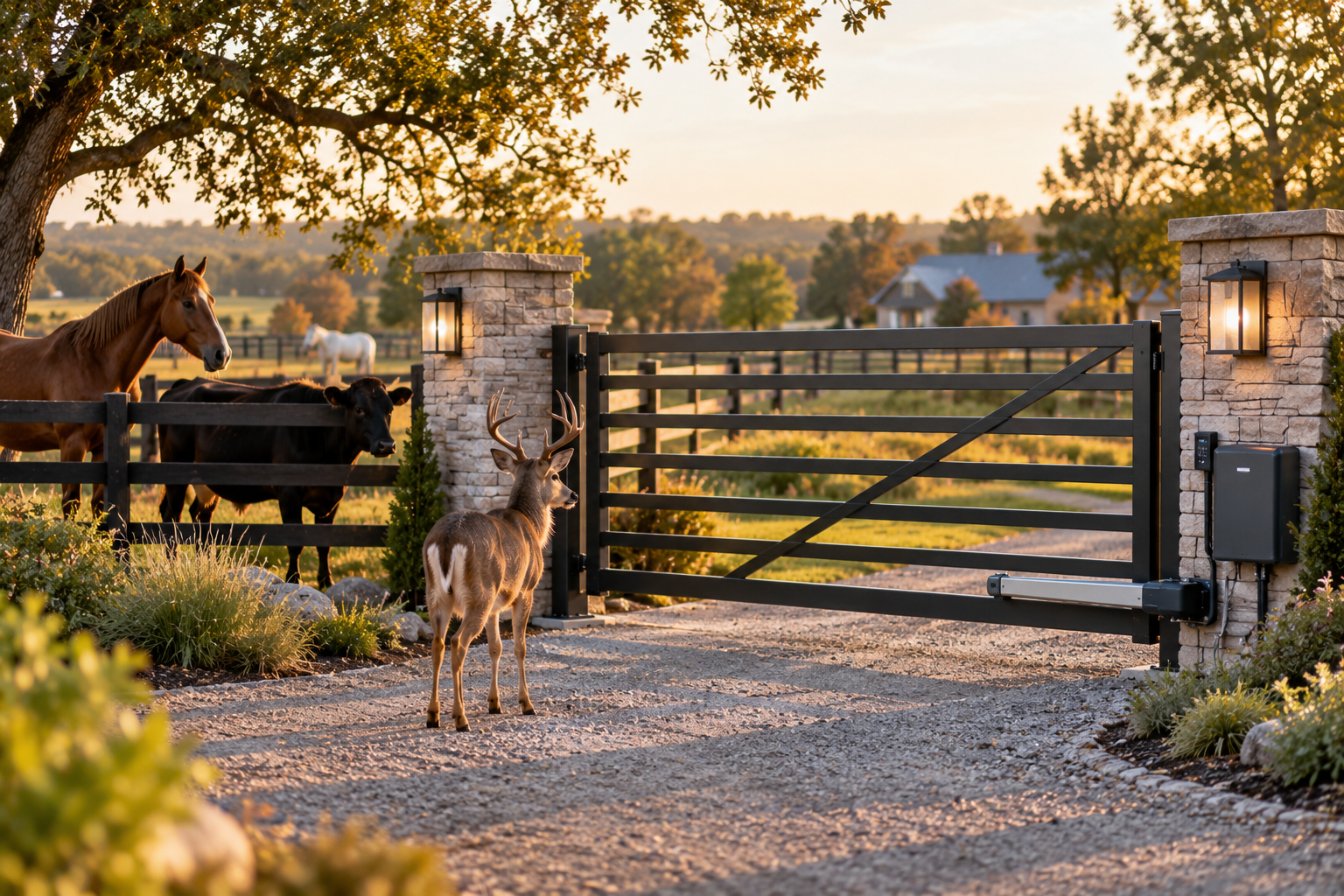
When selecting a custom automated gate, architectural aesthetic is often the top priority. However, the physical properties of the chosen material—density, structural rigidity, thermal expansion rate, and moisture absorption—directly dictate the mechanical requirements of the gate operator.
Pairing a high-density architectural material with an underrated gate opener leads to premature motor failure, stripped gearboxes, and sagging hinge posts. This technical guide evaluates four popular custom gate materials from a structural engineering standpoint, detailing how material science impacts operator selection, hinge specification, and duty cycle requirements.
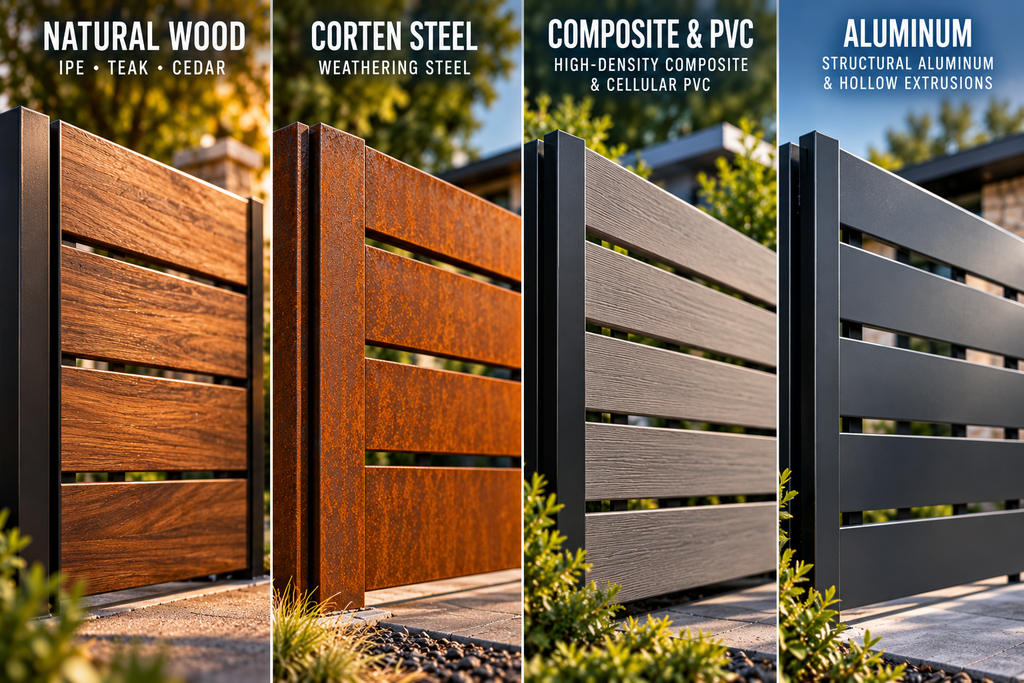
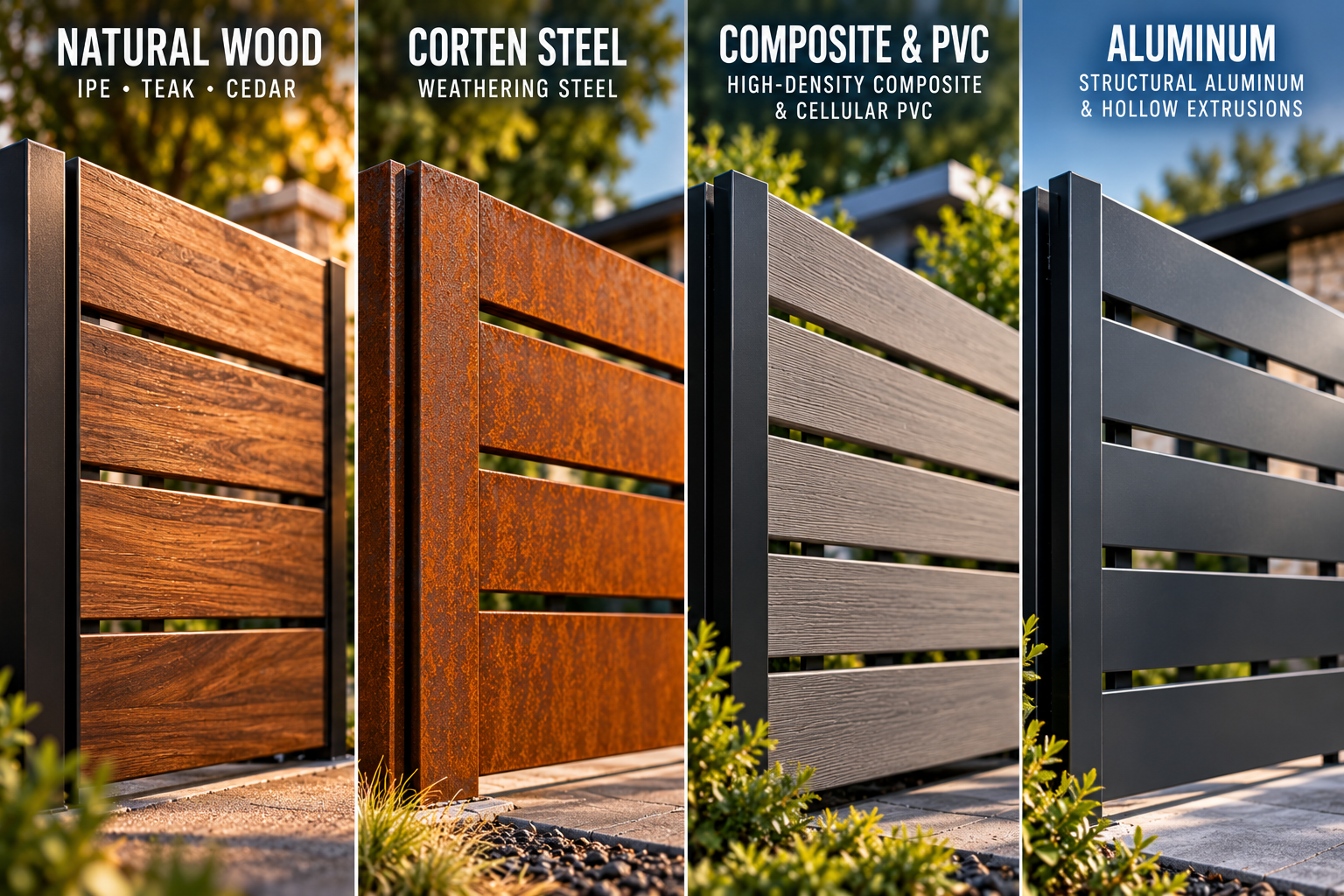
1. Dense Hardwoods (Ipe, Teak, and Western Red Cedar)
Natural wood provides timeless warmth and privacy, but dense tropical hardwoods present severe mechanical engineering challenges due to extreme weight and hygroscopic moisture retention.
Density & Moisture Absorption Mechanics
- Mass & Dead Weight: Tropical hardwoods like Ipe (Handroanthus spp.) are exceptionally dense, weighing roughly 65 to 75 lbs per cubic foot (compared to standard Western Red Cedar at 23 lbs/cu. ft.). A solid 12-foot Ipe gate panel can easily exceed 800 to 1,200 lbs.
- Moisture-Induced Mass Fluctuation: Wood is a hygroscopic material that absorbs ambient atmospheric moisture. During rainstorms or high-humidity seasons, a solid wood gate leaf can gain up to 15% to 20% additional water weight, placing fluctuating load demands on the operator.
- Warping & Torsional Twist: As wood dries and absorbs moisture, unbraced panels twist. This torsional movement misaligns strike plates and binds sliding gate guide rollers.
 [ WET / HUMID SEASON ]                      [ DRY SEASON ]
 +-----------------------+                  +-----------------------+
 | Ipe Wood Panel        |                  | Ipe Wood Panel        |
 | (+15-20% Water Weight)|                  | (Contracted / Dried)  |
 | Weight: 1,150 lbs     |                  | Weight: 980 lbs       |
 +-----------------------+                  +-----------------------+
            ||                                         ||
 (Requires High-Torque Motor)              (Latch Realignment Needed)
Automation & Hardware Solutions
- Over-Specifying Operator Torque: Select heavy-duty hydraulic swing operators rated for at least 1.5x the dry weight of the gate to handle seasonal moisture mass increases.
- Steel Internal Frame Skeletons: Never construct a structural gate purely out of wood. Mount hardwood infill boards onto a rigid, welded structural steel or heavy-gauge aluminum box frame to prevent panel warping.
2. Corten Steel (Weathering Steel)
Corten steel is prized in modern architecture for its distinct, self-passivating rust patina. It eliminates the need for paint while offering high tensile strength.
Structural Weight & Patina Dynamics
- High Tensile Mass: Corten steel shares the high density of carbon steel (approx. 490 lbs per cubic foot). Custom laser-cut Corten panels create heavy, rigid gate leaves requiring high initial breakaway torque.
- Runoff & Sensor Staining: During the first 6 to 18 months of atmospheric exposure, Corten sheds iron oxide runoff. If photo-electric safety eyes or underground loop boxes are placed directly under untreated Corten stiles, rust accumulation can obscure sensor lenses.
                      [ CORTEN STEEL PANEL ]
                                |
                   (Self-Passivating Rust Layer)
                                |
             ====== RUNOFF / IRON OXIDE DRIP ======
                                |
              [ PHOTO EYE LENS / REFLECTOR ]
                 (Needs Protective Hooding)
Automation & Hardware Solutions
- Greaseable Sealed Ball-Bearing Hinges: Corten’s mass requires heavy-duty barrel hinges with internal thrust bearings and grease zerk fittings capable of supporting high cantilevered radial and axial loads.
- Protective Sensor Hooding: Recess optical safety sensors inside deep stainless steel or aluminum protective housings to shield lenses from iron oxide drip.
3. High-Density Composite & Cellular PVC
Composite lumber and cellular PVC offer low-maintenance alternatives to natural wood, resisting rot and insect damage. However, their unique thermal movement profiles demand special installation consideration.
Thermal Expansion & Sag Dynamics
- High Linear Thermal Expansion: Unlike wood, which moves primarily with moisture, composites expand and contract significantly with ambient temperature changes ($\Delta T$). A dark composite panel in direct summer sunlight can reach internal temperatures over $60^\circ\text{C}$ ($140^\circ\text{F}$), expanding lengthwise by over $3/8$ inch.
- Low Flexural Modulus (Thermal Sag): Unsupported composite boards lack structural rigidity. Under continuous summer heat, horizontal composite slats can bow or drape if not supported by intermediate frame studs.
Automation & Hardware Solutions
- Floating Mounting Channels: Fasten composite boards using slotted screw holes or floating channel tracks to allow the material to expand and contract without buckling the outer gate frame.
- Generous Catch Gate Clearances: Provide a minimum $3/4$-inch gap at strike columns and guide rollers to prevent heat-expanded panels from binding inside receiving catches.
4. Structural Aluminum & Hollow Extrusions
Architectural aluminum is the gold standard for high-traffic commercial and residential automated gates due to its exceptional strength-to-weight ratio and corrosion resistance.
Inertia & High Duty Cycles
- Low Rotational Inertia: Aluminum weighs roughly one-third as much as steel (approx. 168 lbs/cu. ft.). Lower mass dramatically reduces starting inertia and stopping momentum, allowing gate operators to run at faster opening speeds without slamming.
- High Duty-Cycle Ratings: Because aluminum places significantly less mechanical strain on hinges, internal gearboxes, and motor windings, operators paired with aluminum gates achieve far higher daily open/close duty cycles before thermal overload.
Material Engineering Comparison Matrix
| Material Type | Relative Weight | Environmental Sensitivity | Primary Mechanical Challenge | Best Operator Match |
| Ipe / Tropical Wood | Very Heavy ($65+$ lbs/cu. ft.) | High (Moisture Expansion) | Seasonal weight gain & panel warping | Heavy-duty continuous hydraulic swing |
| Corten Steel | Extremely Heavy ($490$ lbs/cu. ft.) | Low (Self-Passivating) | High starting inertia & hinge strain | High-torque mechanical gear/chain or hydraulic |
| Composite / PVC | Medium-Heavy ($40–55$ lbs/cu. ft.) | High (Thermal Expansion) | Summer sag & thermal expansion binding | Standard mechanical or linear actuator |
| Architectural Aluminum | Light ($168$ lbs/cu. ft.) | Very Low (Corrosion Proof) | Low (Requires structural wind bracing) | Fast-acting high-cycle mechanical drive |
Frequently Asked Questions (FAQ)
Can you automate a solid heavy wood gate?
Yes, but a solid wood gate must be built over a rigid, welded steel or aluminum internal frame to prevent structural warping. The operator must be an industrial, high-torque hydraulic or gear-driven unit rated well above the gate’s maximum wet weight.
Why is aluminum preferred for high-traffic automatic gates?
Aluminum is lightweight and corrosion-resistant, which minimizes rotational inertia and starting drag. This reduces strain on the operator’s motor and gear assembly, allowing the gate to execute high daily open/close cycles reliably without overheating.
How do heat and cold affect composite gate materials?
Composite materials expand in high heat and contract in extreme cold. If built without adequate expansion gaps, heat-expanded composite panels will bow, drag against guide rollers, or jam inside lock strike plates.
Engineering Custom Automated Gates
Matching gate materials with the correct structural frame, hinge hardware, and operator torque profile requires a thorough understanding of physical forces. Consulting with certified gate technicians ensures your custom architectural gate is engineered for lasting reliability and effortless automated operation.
Engineer Your Commercial Perimeter for Maximum Durability
Choosing the right material is only the first step in building a high-performance automated gate system. To ensure seamless integration, proper operator torque matching, and long-term reliability under demanding duty cycles, expert engineering is essential.
- Explore our complete range of engineered perimeter solutions on the Weaga Home Page.
- Learn more about our specialized commercial capabilities by visiting our Commercial Gate Automation and Loading Dock Services page.