Modern automated gates do far more than turn an electric motor—they act as digital network nodes connected to Wi-Fi, mobile apps, long-range RFID, and cloud platforms. While smart connectivity offers incredible convenience, it also exposes perimeter security to cyber-physical threats.
If an automated gate uses outdated radio frequencies or an unencrypted wireless network, unauthorized actors can intercept RF signals, clone digital credentials, or bypass physical locks entirely. This technical guide breaks down how gate signal vulnerabilities work and how to implement defense-in-depth strategies to secure your perimeter entry points.
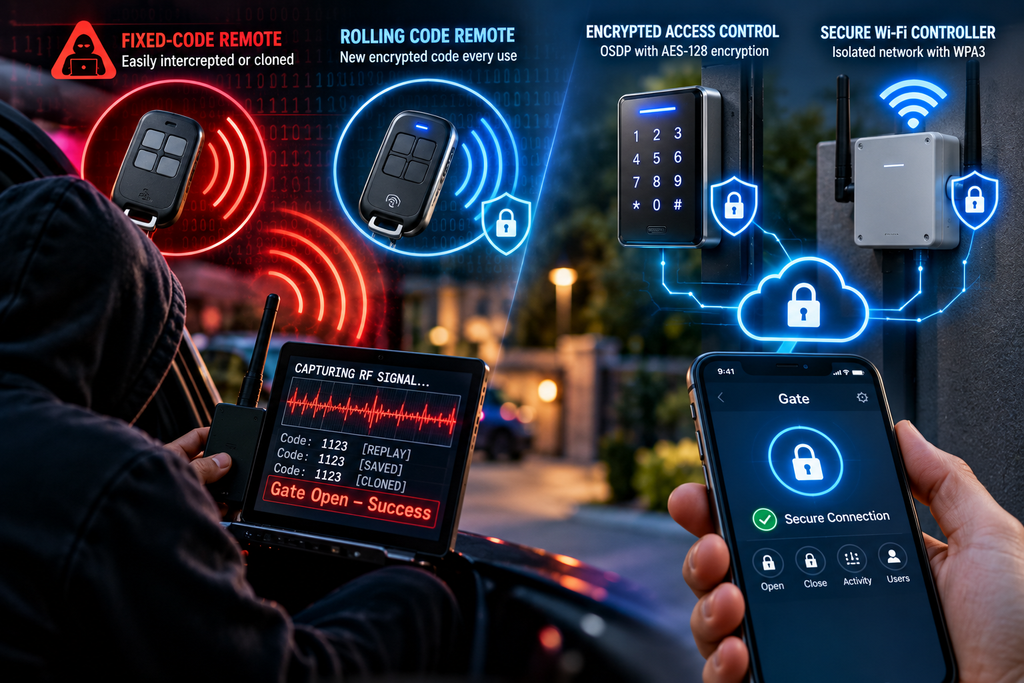
1. The Death of Fixed-Code Remotes: DIP Switches vs. Rolling Codes
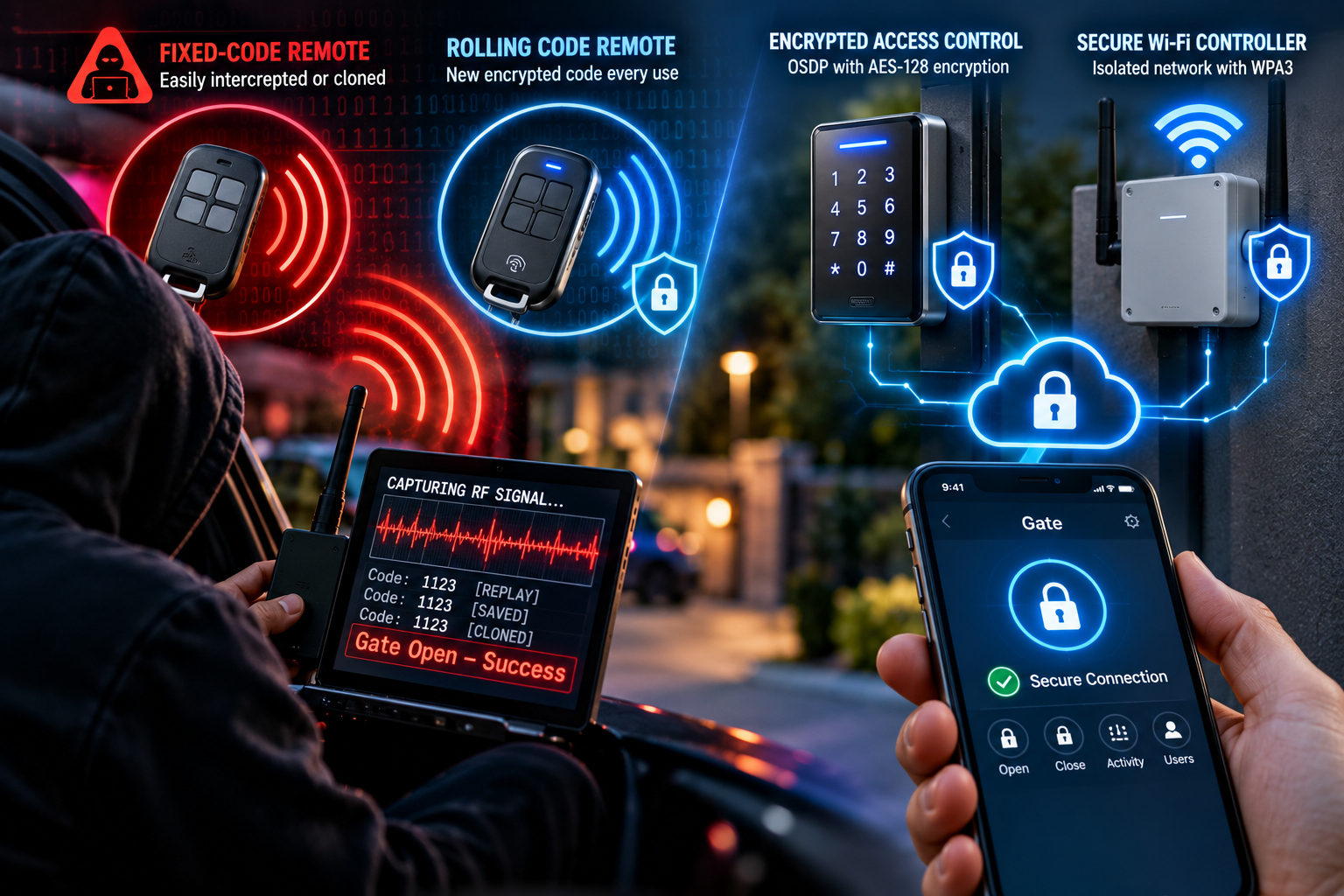
Legacy automated gate openers relied on fixed binary or trinary DIP switches inside the remote control and receiver. These static codes send the exact same radio signal every time you press the button.
The Vulnerability of Fixed Codes
- RF Signal Sniffing & Replay Attacks: Anyone standing within radio range (up to 300 feet) using a low-cost RF receiver or software-defined radio (SDR) can record the fixed frequency code transmitted through the air.
- Brute-Force Scanning: Fixed DIP-switch remotes typically offer only 256 to 1,024 code combinations. A simple handheld code scanner can cycle through every possible code in under two minutes, opening the gate without physical damage.
The Fix: Security+ Rolling Code Technology
Modern automated gate receivers utilize pseudo-random rolling code algorithms (such as KeeLoq or Security+ 2.0).
 [ REMOTE CONTROL ]                           [ GATE RECEIVER ]
      |                                              |
      |-- Transmits Code #40921 + PRNG Hash -------->|-- Checks counter sync
      |                                              |-- Validates hash
      |                                              |-- Opens Gate & EXPIRES Code #40921
- Dynamic Code Expiration: Every time the remote button is pressed, an internal Pseudo-Random Number Generator (PRNG) creates a brand-new cryptographic passkey based on a shared secret key and counter.
- Replay Immunity: Once the receiver validates Code #40921, that code immediately expires. Even if an attacker intercepts and records the transmission over the air, replaying it later will be rejected by the gate receiver.
2. Encrypted Access Control: RFID, Wiegand, and OSDP Protocols
For commercial facilities, HOAs, and gated estates, access control terminals (keypads, card readers, and vehicle windshield tags) route credential data to a central controller.
 [ OLD WIEGAND SYSTEM ]
 Keypad/Reader ======= (Unencrypted 2-Wire Transmission) =======> Gate Controller
                                   ||
                    [ Attacker Taps Wire / Sniffs Data ]

 [ MODERN OSDP SYSTEM ]
 Keypad/Reader <==== (AES-128 Encrypted Bidirectional Channel) ====> Gate Controller
The Vulnerability of Legacy Wiegand Wiring
For decades, physical access control readers communicated using the unencrypted Wiegand protocol.
- Because Wiegand sends data in plain text across two wire leads (Data 0 and Data 1), an attacker can attach a small covert micro-logger inside the keypad pedestal to record card numbers or PINs as they pass through the wires.
Upgrading to OSDP (Open Supervised Device Protocol)
- AES-128 Bit Encryption: Modern gate controllers use OSDP v2, which encrypts all data transmitted between the external keypad or RFID reader and the internal control panel.
- Continuous Monitoring: OSDP maintains a two-way supervised connection. If an attacker attempts to tamper with or snip the reader wiring, the controller immediately detects the signal break and triggers a tamper alarm.
3. Securing Smart Gate Hubs & Wi-Fi Gate Controllers
Integrating an automated gate into a smart home system or mobile app allows remote operation from anywhere in the world. However, connecting an IoT gate controller directly to your primary Wi-Fi network introduces network-layer risks.
 PRIMARY NETWORK           GUEST / IoT VLAN (Isolated)
 +-------------------+     +----------------------------+
 |  Laptops, PCs     |     |  Smart Gate Opener         |
 |  NAS Drives       |  x  |  Wi-Fi Cameras             |
 |  Personal Data    | <---> (Traffic Blocked via Firewall)|
 +-------------------+     +----------------------------+
Network Hardening Steps for Smart Gates
- Network Segmentation (VLANs): Never put a smart gate controller on your main home or corporate network. Place all IoT gate devices on a dedicated, isolated Virtual Local Area Network (VLAN) so a compromised smart device cannot act as a pivot point to reach computers or sensitive files.
- Enforce WPA3 Wireless Encryption: Ensure the outdoor Wi-Fi access point serving your gate pedestal utilizes WPA3 Enterprise/Personal encryption to prevent wireless handshake cracking.
- Multi-Factor Authentication (MFA): Enable biometric authentication (FaceID / Fingerprint) and 2FA on any smartphone application capable of sending an open command to the gate.
Physical vs. Digital Security Matrix
| Security Feature | Legacy / Vulnerable Setup | Modern Secured Standard |
| Radio Remotes | Fixed DIP Switch (8–10 Pin) | Multi-Band Rolling Code (Security+ 2.0 / 128-bit) |
| Pedestal Wiring | Unencrypted Wiegand Protocol | AES-128 Encrypted OSDP Protocol |
| Smart App Network | Primary Wi-Fi Subnet | Isolated IoT VLAN with WPA3 Encryption |
| Credential Storage | Local Plaintext EEPROM | Hardware Secure Element / Cryptographic Key Storage |
Frequently Asked Questions (FAQ)
Can someone hack an electric gate remote?
Legacy electric gate remotes using fixed DIP-switch frequencies can be easily intercepted or brute-forced using cheap radio frequency scanners. Modern systems using rolling code technology change the transmission frequency and code with every button press, making signal cloning practically impossible.
What is the most secure way to control an automated gate?
The most secure setup combines rolling code RF remotes, an OSDP-encrypted keypad or reader, and a smart gate controller isolated on its own encrypted network (VLAN) protected by multi-factor authentication.
What is a replay attack on an automatic gate?
A replay attack occurs when a hacker uses a radio receiver to intercept and record the open command sent from your remote control through the air, and then replays that exact recorded signal later to open your gate. Rolling code receivers prevent this by invalidating each code as soon as it is used.
Expert Cyber-Physical Gate Protection
Protecting an automated gate requires a balanced security posture that addresses both physical mechanical entry and digital wireless vulnerabilities. Partnering with professional gate automation technicians ensures your access control hardware, radio receivers, and smart network interfaces are engineered to withstand modern intrusion threats.