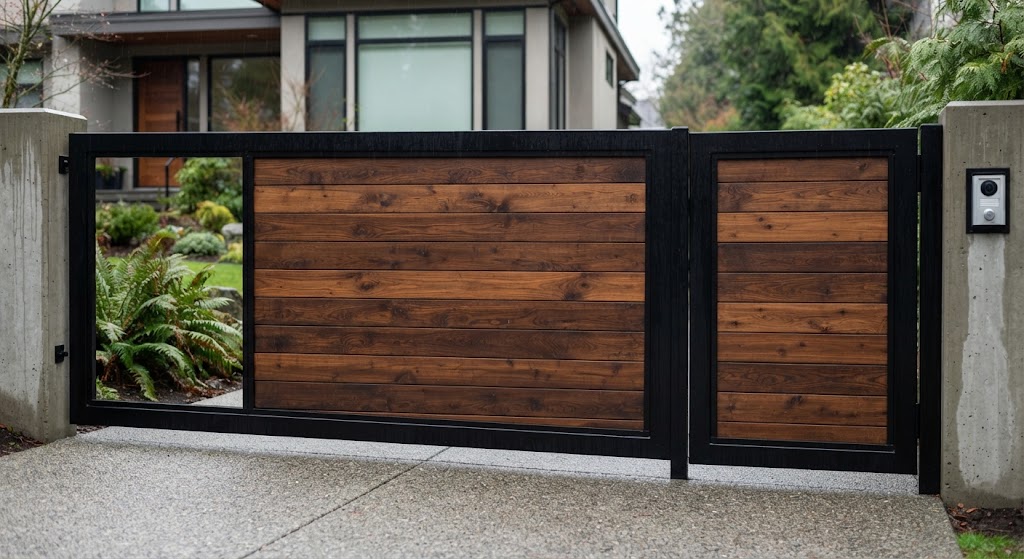
Automated driveway and security gates face continuous mechanical stress from environmental physics. While standard gate operators perform effortlessly in mild weather, extreme environmental conditions—gale-force wind loads, sub-zero freezing temperatures, and blistering summer heat waves—can freeze motors, snap hinges, strip internal gears, or trigger nuisance safety reversals.
Understanding how environmental physics impacts gate mechanics is essential for selecting the right operator, sizing hinges, and specifying climate-rated hardware. This technical guide breaks down the physical forces exerted on gate systems and how specialized engineering keeps them operating reliably year-round.
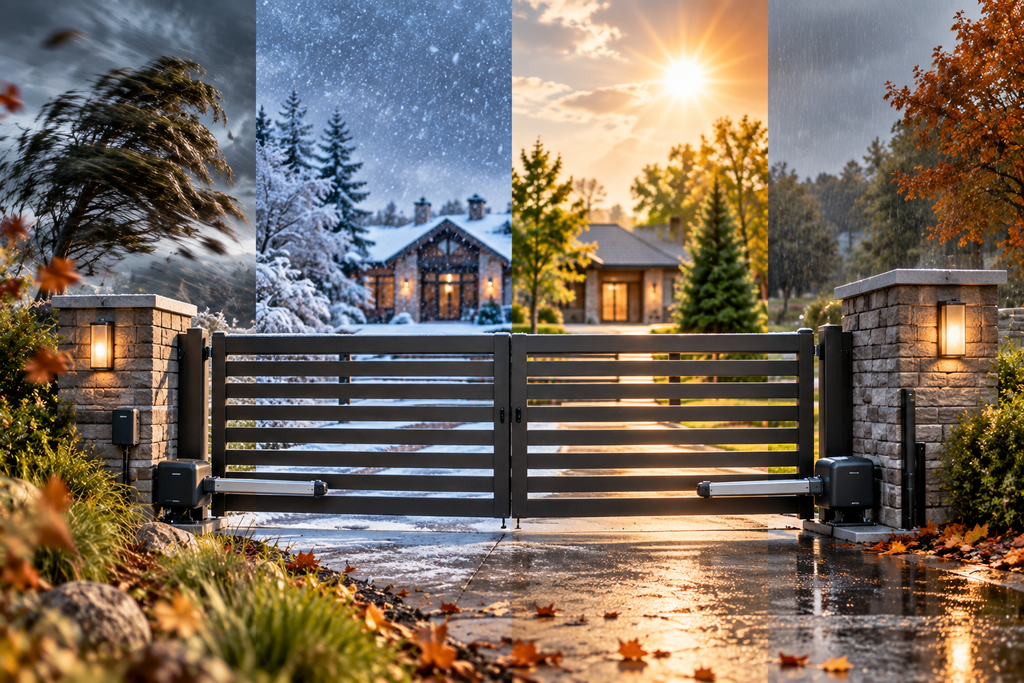
1. Wind Load Physics: The Sail Effect on Solid Gates
Wind pressure is one of the leading causes of premature operator gear failure and motor burnout. When wind strikes a gate panel, the force exerted depends heavily on panel surface density, gate length, and wind velocity.
The Physics of Wind Pressure
Wind load force increases exponentially with wind speed. The structural force exerted on a gate panel can be estimated using the basic dynamic pressure formula:
$$P = 0.00256 \times V^2$$
(Where $P$ is pressure in pounds per square foot, and $V$ is wind speed in miles per hour.)
For a solid wood, privacy composite, or full-metal sheet gate, a 50 mph wind gust exerts over 6.4 lbs of force per square foot. On a standard 12-foot wide by 6-foot tall solid gate leaf (72 sq. ft.), this generates over 460 lbs of continuous lateral force directly against the gate arm and operator gearbox.
                    WIND DIRECTION  ===>  ===>  ===>
       __________________________________________________
      |                                                  |
      |   SOLID GATE PANEL (Acts like a giant sail)      |   ===> 460+ lbs Lateral Force
      |__________________________________________________|
                                |
                   HEAVY-DUTY OPERATOR ARM / HINGE
               (Absorbs severe rotational torque)
Engineering Solutions for High-Wind Areas
- Hydraulic vs. Mechanical Drive: Hydraulic swing operators utilize incompressible fluid cycles and internal pressure relief valves, allowing them to cushion heavy wind gusts without stripping mechanical teeth or nylon gears.
- Open-Slat Architectural Designs: Utilizing louvered panels, horizontal slats with 20–30% open airflow gaps, or decorative wrought iron significantly reduces wind resistance while maintaining privacy.
- Positive Mechanical Locks & Solenoids: Installing heavy-duty electric pin locks or solenoid latches at the meeting stiles prevents wind forces from twisting the gate open and damaging operator arm mounting brackets.
2. Sub-Zero Freeze Physics: Viscosity, Battery Drop, & Frost Heave
Freezing temperatures present severe mechanical and electrical obstacles to gate automation systems. Cold weather affects fluid mechanics, chemical battery storage, and sub-surface soil stability.
               [ FROST LINE / HEAVE SHIFT ]
                         |   |
  ====================== | = | ====================== GROUND LINE
        ||               |   |                ||
        ||               |   |                ||
     CONCRETE          SOIL EXPANSION       CONCRETE
     FOOTING           FROST HEAVE          FOOTING
     (POST A)                              (POST B)
Hydraulic Fluid Viscosity
Standard hydraulic oil thickens significantly as temperatures drop below freezing ($0^\circ\text{C}$ / $32^\circ\text{F}$). High-viscosity oil increases pump resistance, causing the operator to draw excess current, run slowly, or trigger internal overload thermal breakers.
- The Solution: Use synthetic low-temperature arctic hydraulic fluids rated for $-40^\circ\text{C}$ to maintain low kinematic viscosity during winter months.
Chemical Battery Voltage Drop
Lead-acid and lithium-ion backup batteries experience a significant drop in chemical reaction rates during freezing weather. A battery operating at $-10^\circ\text{C}$ ($14^\circ\text{F}$) can lose up to 40% to 50% of its rated amp-hour capacity, potentially leaving gates inoperable during winter power outages.
- The Solution: Install thermostatically controlled enclosure heaters (cabinet warmers) inside control board boxes to keep batteries and microprocessors within optimal operating temperatures.
Soil Frost Heaves & Post Misalignment
When moisture in the soil freezes, it expands by roughly 9%, creating upwards and sideways soil movement known as frost heave. If gate posts are set above the local frost line, soil movement tilts the posts inward, binding hinges and jamming sliding gate tracks.
- The Solution: Set gate mounting posts in concrete footings that extend below the regional frost depth line.
3. Thermal Expansion: Metal Movement in High Heat
Direct sunlight and thermal radiation cause metal components to expand during summer heatwaves.
Material Thermal Expansion Formulas
Linear thermal expansion measures how much a gate leaf expands in length when heated:
$$\Delta L = \alpha \times L \times \Delta T$$
(Where $\alpha$ is the coefficient of thermal expansion, $L$ is length, and $\Delta T$ is temperature change.)
A 16-foot aluminum or steel gate panel exposed to a $40^\circ\text{C}$ ($72^\circ\text{F}$) seasonal temperature swing can expand by over $1/8$ to $1/4$ inch in overall length.
   <-- [ expansion ] -- 16-FOOT METAL GATE LEAF -- [ expansion ] -->
   =================================================================
   |                                                               |
   |               SUMMER THERMAL EXPANSION DRIFT                  |
   =================================================================
                            ||                      ||
                 [ Hinges Bind / Stiff ]    [ Latch Alignment Shifts ]
Impact on Gate Functionality
- Latch & Lock Binding: Minimal clearance between sliding gate guide rollers or magnetic latches can cause the gate to jam shut as the panel lengthens.
- Hinge Stiffness: Ungreased ball-bearing hinges expand internally, creating extreme mechanical drag that triggers motor force limit reversals.
- The Solution: Utilize heavy-duty, adjustable ball-bearing hinges with grease zerk fittings, and leave adequate clearance (minimum $1/2$ to $3/4$ inch) at strike plates and solenoid latch housings.
Extreme Weather Engineering Comparison
| Environmental Hazard | Primary Physical Impact | Recommended Hardware & Setup |
| High Winds (40+ mph) | High rotational torque on gears and arm brackets | Hydraulic operators, louvered/slatted panels, positive solenoid locks. |
| Sub-Zero Temperatures | Thickened hydraulic fluid, frozen battery chemical output | Synthetic arctic fluid, cabinet enclosure heaters, heavy-duty AGM batteries. |
| Direct Summer Heat | Metal expansion ($\Delta L$), ungreased hinge friction | Adjustable heavy-duty hinges, silicone/lithium grease with high drop points. |
| Frost Heave & Freezing Ground | Upward post displacement and track bowing | Concrete footings sunk deeper than the local frost line, adjustable hinge pins. |
Frequently Asked Questions (FAQ)
What type of gate operator is best for high-wind areas?
Hydraulic gate operators are superior for high-wind locations. Because hydraulic systems compress fluid rather than relying purely on mechanical metal gears, they absorb wind shock loads without stripping internal teeth.
Why does my automatic gate stop or reverse in freezing weather?
Freezing weather causes hydraulic fluid to thicken and grease on hinges to harden, increasing physical resistance. The operator senses this drag as an obstacle and reverses for safety. Installing arctic fluid and greasing hinges resolves this issue.
How deep should automatic gate posts be installed?
Gate posts must be set in concrete footings below your regional frost line depth to prevent frost heave from shifting posts and misaligning safety sensors or locking latches.
Engineered Gate Automation for Any Climate
Designing an automatic gate system that withstands extreme weather requires balancing structural physics with heavy-duty mechanical engineering. Consulting with certified gate technicians ensures your operator, hinge hardware, and foundation are specified to handle high winds, severe cold, and summer heat without unexpected downtime.