When an emergency occurs, seconds count. For gated residential communities, commercial facilities, and private estates, secure perimeter protection must never impede fire engines, police cruisers, or ambulances. Standard keypad codes and remote clickers are inadequate for first responders who need immediate, frictionless access.
To maintain security while complying with municipal fire codes and international building standards, automated gate systems incorporate specialized emergency access overrides. This technical guide examines the primary override technologies that allow emergency services to bypass locked automated gates automatically or manually.
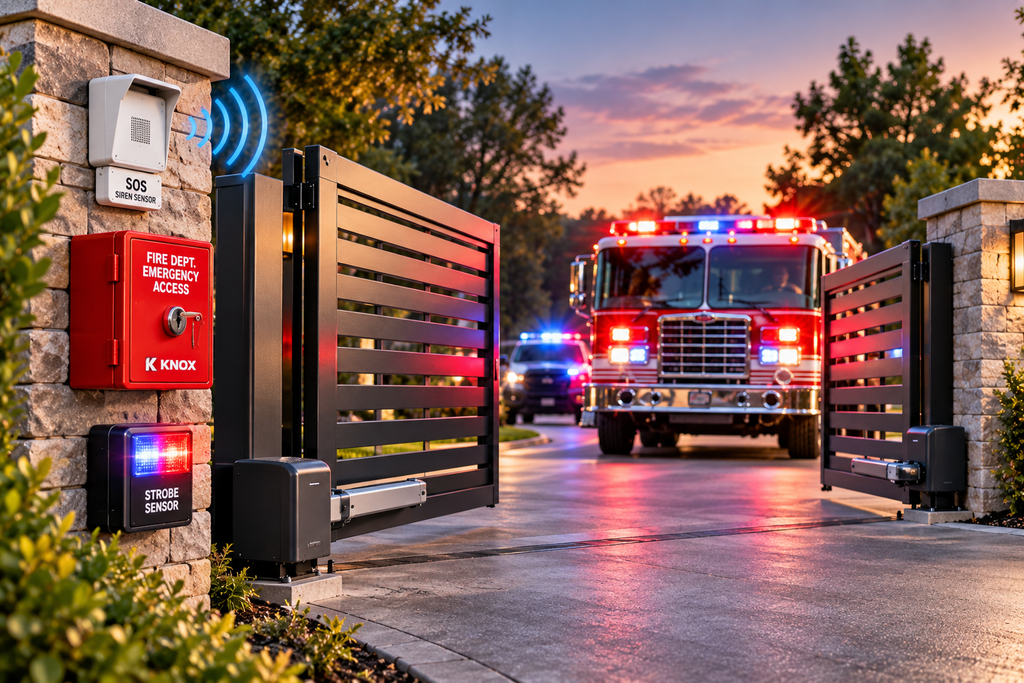
1. Acoustic Siren Sensors (SOS Emergency Access)
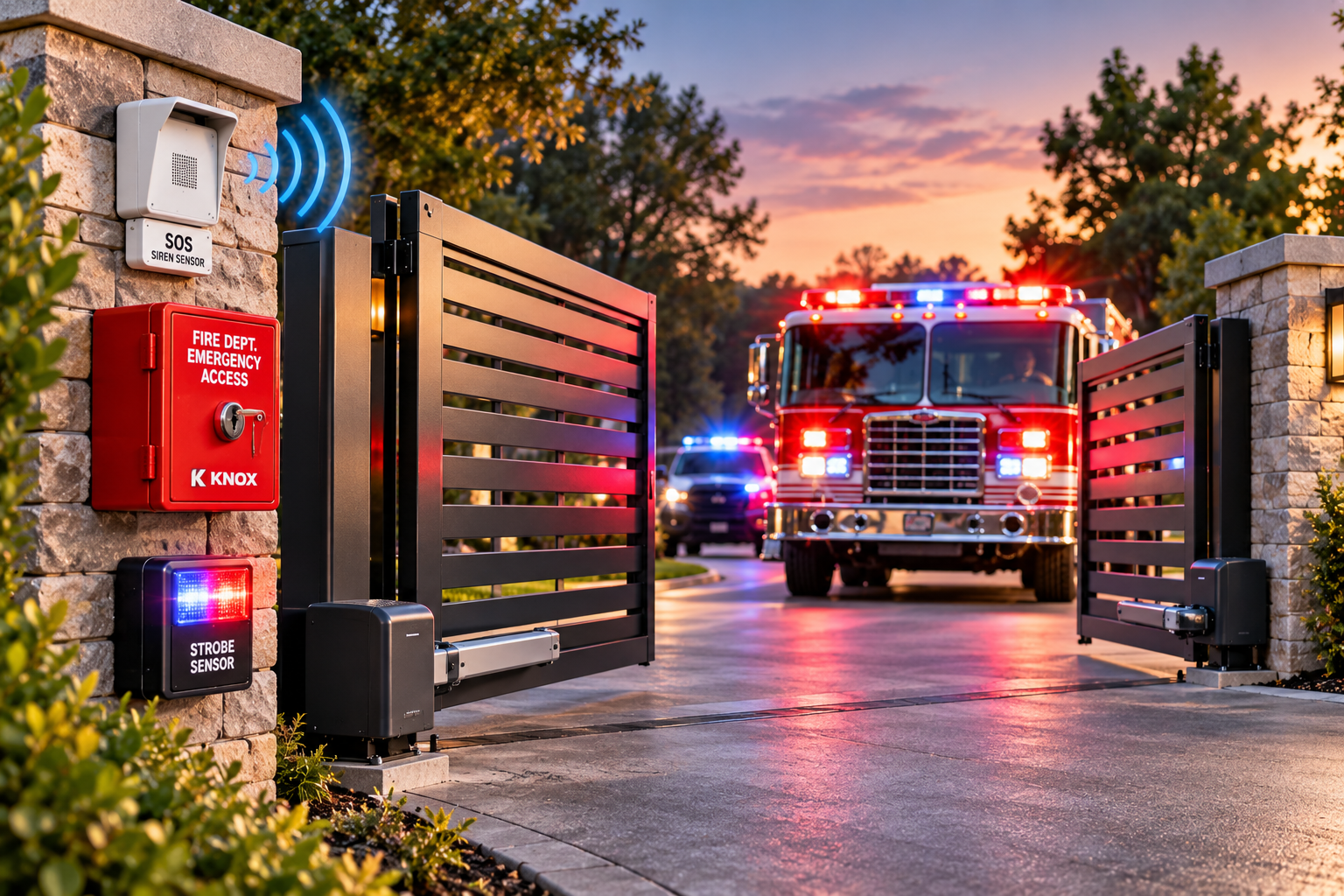
Acoustic siren sensors—commonly known as SOS (Siren Operated Sensor) units—are electronic receiver modules mounted near the gate operator. They detect the specific frequency patterns emitted by emergency vehicle sirens.
How Siren Sensors Work
- As an emergency vehicle approaches, the acoustic sensor captures incoming sound waves through a weatherproof microphone.
- The internal microprocessor filters ambient noise and evaluates the sound profile for standard emergency siren tones (such as Yelp, Wail, or Hi-Lo patterns).
- Upon validating a continuous 2.5 to 4-second siren burst, the sensor sends a dry contact closure signal directly to the gate operator’s control board, triggering an immediate full-open cycle.
 [ APPROACHING AMBULANCE ]
        || (Siren Frequency: 0.5 kHz - 1.5 kHz)
        \/
 [ ACOUSTIC SOS MICROPHONE ]
        ||
 [ FREQUENCY ANALYZER / BOARD ]  ===> (Dry Contact Trigger) ===> [ GATE OPENER ]
- Key Advantage: Requires no physical contact, specialized keys, or radio hardware carried inside the emergency vehicle.
- Pro-Tip for Reliability: Acoustic sensors must be calibrated properly to prevent false triggers from loud heavy machinery or thunder, while remaining sensitive enough to detect sirens from 50 to 100 feet away.
2. Knox Key Switches & Physical Emergency Locks
A Knox Box key switch is a high-security mechanical override system standardized across fire jurisdictions nationwide. Local fire departments carry a single, highly protected master key that operates Knox key switches within their specific district.
Knox Switch Operation
- Keyed Switch Activation: Mounted in a visible location near the gate entry, a master key is inserted and turned in the Knox switch housing.
- Latch Maintenance Mode: Turning the key holds the gate in the fully open position indefinitely, ensuring that secondary responding units (e.g., additional fire engines or support vehicles) do not get locked out while responding to an active incident.
 +----------------------------------+
 |        KNOX KEY SWITCH           |
 |   [ RED WEATHERPROOF HOUSING ]   |
 |                                  |
 |        (Master Fire Key)         |
 |                ||                |
 |            (Turn Key)            |
 |                ||                |
 |     Sends Latch Open Signal      |
 +----------------------------------+
3. Strobe Light & Optical Sensors
Optical emergency receivers use specialized light sensors to detect high-intensity flashing strobes emitted by emergency vehicles (such as Opticom or priority emitter systems).
- How It Operates: The sensor detects the calibrated flash frequency (typically 10 to 14 Hz) of an approaching vehicle’s optical strobe array.
- Line-of-Sight Requirements: Unlike omnidirectional acoustic sensors, optical receivers require a clear line of sight down the approach driveway to capture incoming light pulses reliably.
4. Power Outage Fail-Safes: Fail-Safe vs. Fail-Secure
During major emergencies, municipal power lines may go down. Automated gates must have redundant systems to ensure emergency vehicle access during grid failures.
| Override System | Operation During Power Failure | Best Application |
| DC Battery Backup | System automatically switches to internal AGM/lithium battery power to maintain normal or emergency opening cycles. | All residential and commercial gated entries. |
| Fail-Safe Release (Automatic Drop/Open) | Upon total power loss, a magnetic lock releases or a solenoid valve drops fluid pressure, automatically pulling or swinging the gate open. | High-occupancy commercial properties, hospitals, and emergency egress routes. |
| Fail-Secure Manual Release | Gate remains mechanically locked in place until manually unlocked using a physical release key or mechanical lever. | High-security facilities, industrial yards, and perimeter storage infrastructure. |
Municipal Compliance & UL 325 Standards
Under UL 325 Safety Standards, emergency access control devices (such as Knox switches or SOS sensors) are permitted exemptions from standard access control placement rules. While general user keypads must be installed at least 6 feet away from moving gate parts to prevent injury, authorized emergency access controls may be mounted closer to the gate, provided they remain within clear line-of-sight of the entryway.
Essential Emergency Access Installation Checklist
- [ ] Local Fire Marshal Approval: Verify that chosen override devices match local jurisdiction requirements before installation.
- [ ] Dual-Technology Redundancy: Install both an acoustic sensor (SOS) and a physical Knox key switch for maximum reliability.
- [ ] Pre-Set Hold Open Timers: Program the control board so that emergency overrides keep the gate locked open until manually reset by first responders or property management.
- [ ] Visible Signage: Ensure Knox key switch pedestals are clearly marked with reflective emergency access signage.
Frequently Asked Questions (FAQ)
How do fire trucks get through automatic driveway gates?
Fire trucks access automated gates using standardized emergency overrides: acoustic siren sensors (which detect siren tones and open automatically), optical strobe detectors, Knox master key switches, or radio frequency clickers assigned to local emergency departments.
What is a Knox switch on an automatic gate?
A Knox key switch is a heavy-duty, weatherproof electrical switch housed in a secure lock box. Local fire departments carry a master key that fits the switch, allowing first responders to open and hold the gate open during an emergency.
What happens to an automated gate when the power goes out?
Modern automated gates feature battery backup systems that continue operating the gate for dozens of cycles. In the event of total battery depletion, gates configured as “fail-safe” will automatically release their mechanical locks or swing open to allow free vehicle passage.
Technical Emergency Access Planning
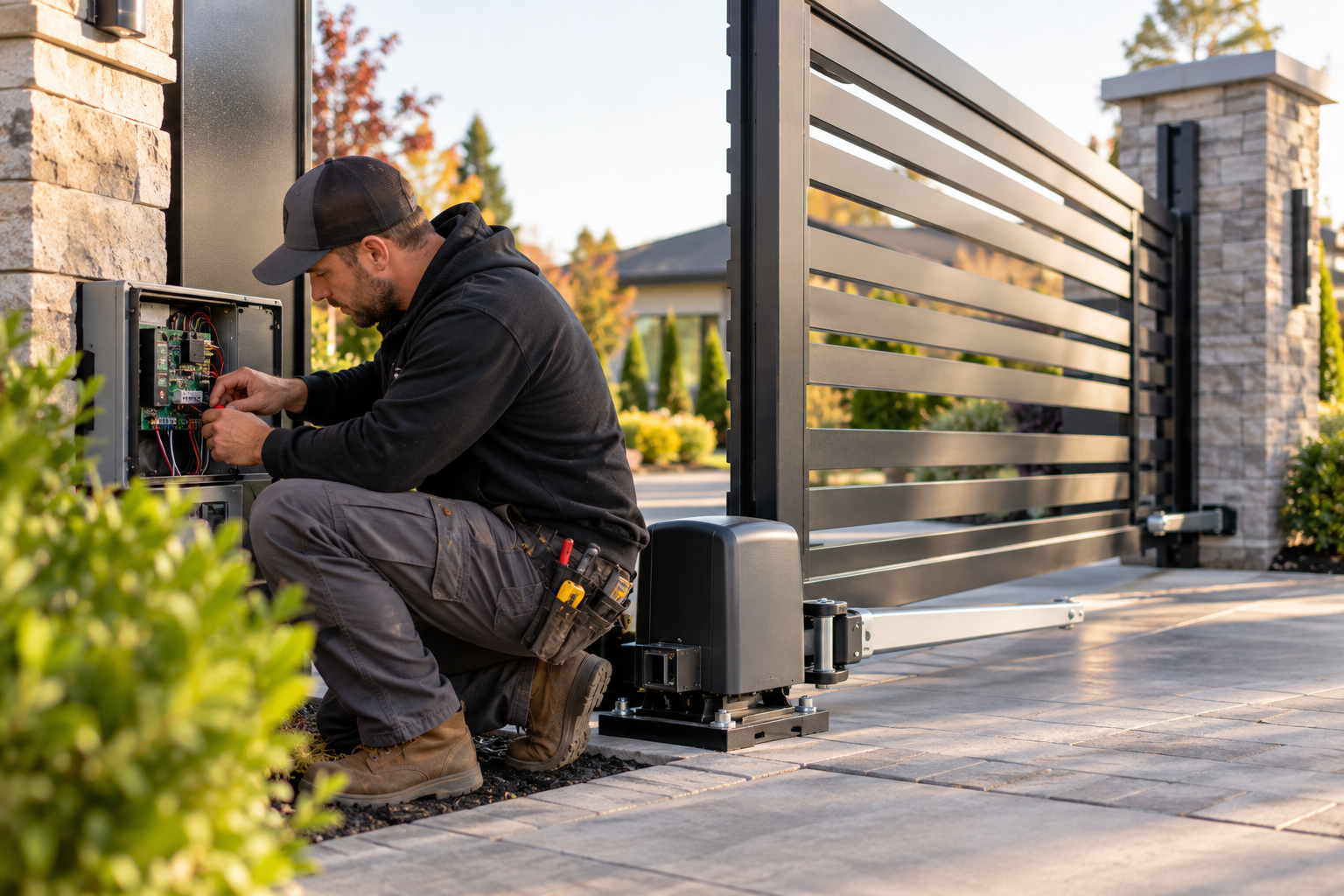
Engineering an automated gate for emergency access requires balancing perimeter security with municipal life-safety regulations. Working with certified gate technicians ensures your perimeter entry system is fully compliant with local fire marshal requirements and built for instant, reliable first-responder access.
SEO & Optimization Details
- Focus Keyphrase: emergency access gate automation
- SEO Title: Emergency Access Gate Automation: Knox Switches & SOS Sensors
- Meta Description: Learn how automated gates provide instant access to fire, police, and EMS. Explore Knox Key Switches, SOS acoustic sensors, strobe receivers, and fail-safes.
- Slug: emergency-access-gate-automation-engineering
- Excerpt: Gated properties must provide instant access for emergency responders without compromising security. This technical guide breaks down Knox key switches, acoustic siren sensors, strobe receivers, and power-fail safety standards for automated gate systems.
Check out this Knox Box Rapid Access Control System Overview video to see how local fire departments utilize master key switch systems to bypass perimeter locks during emergency calls.