Why Sagging Gates Destroy Motors
When it comes to automatic driveway gates Vancouver properties rely on, perfect physical symmetry is essential for the system to function correctly. If your gate leaves, hinges, or posts fall out of alignment by even a few millimeters, it triggers a domino effect of mechanical and electrical issues. A misaligned gate is far more than a cosmetic flaw—it is an active threat to your property’s perimeter and a fast track to needing expensive electric gate repair Vancouver services or a complete motor replacement.
Whether you manage heavy-duty commercial security gates Vancouver businesses depend on or private electric driveway gates Vancouver homeowners use, recognizing the early signs of gate sagging and addressing them immediately is crucial. Discover the risks of ignoring a crooked gate, how the local elements cause it, and how Wilson Electrical and Gate Automation (WEAGA) delivers the proactive automatic gate maintenance Vancouver and precision structural fixes needed to keep your system running smoothly.
What causes an automatic gate to become misaligned?
Automatic gates become misaligned due to ground shifting, worn or unlubricated hinges, loose hardware, vehicle impacts, and structural post-sagging caused by Vancouver’s heavy rainfall eroding the concrete footings. Over time, the physical weight of the gate pulls the panels downward, preventing them from meeting correctly at the center latch.
Can a misaligned gate ruin an automatic gate opener motor?
Yes, a misaligned gate will rapidly destroy an automatic gate opener motor. When gate panels sag or drag, it creates immense physical resistance. This forces the operator motor to work twice as hard to move the gate, resulting in overheated circuit boards, stripped internal gears, and premature total motor failure.
The Major Problems If You Don’t Fix a Sagging Gate
It can be tempting to ignore a gate that is only slightly crooked, especially if it still manages to squeeze shut. However, delaying a structural alignment check leads to three severe consequences:
1. Lock Failures and Security Risks
Automatic gates require precise alignment to lock securely. While a dragging or crooked gate looks cosmetic, it is a security risk. A misaligned gate also strains your opener motor, causing the system to burn out over time.
2. Motor and Gearbox Failure
Gate operators are built to move a perfectly balanced load. If a gate drags or binds, the motor experiences massive strain. Operating a crooked gate for just a few weeks can burn out the windings or break the drive chain. This turns a simple hinge adjustment into an expensive replacement.
3. Destruction of Gate Track, Rollers, and Hinges
Misalignment forces sliding gate rollers to grind heavily against the frame and track. On swing gates, a sagging panel twists the hinges. Left uncorrected, this friction warps metal tracks and snaps heavy-duty components.
Common Signs Your Gate is Out of Alignment
Catch these warning signs before your automated system suffers a complete mechanical breakdown:
Scrape Marks on the Driveway: Visible lines or gouges on your pavement mean the gate panel is actively sagging and dragging.
The Gate Reverses Mid-Cycle: Modern gate motors feature built-in obstruction sensitivity. If the gate binds or encounters resistance due to a crooked frame, the computer assumes it hit an object and will short-cycle or reverse.
Loud Grinding or Groaning Noises: Heavy structural friction or popping sounds from the hinges indicate the gate’s weight is distributed unevenly.
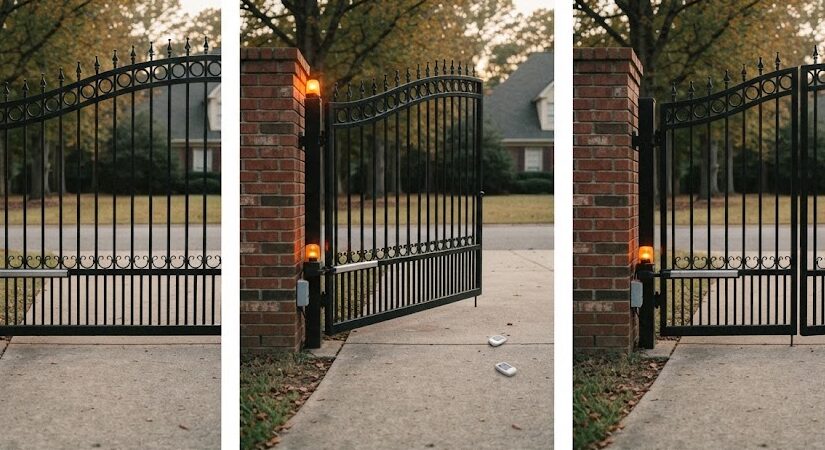
Gaps at the Center Latch: On double-swing gates, if the two panels don’t form a straight, level line when closed, structural shifting has occurred.
How WEAGA Fixes a Misaligned Gate
At Wilson Electrical and Gate Automation, we don’t just grease a squeaky hinge and leave. We treat gate alignment as a precise structural engineering task. Our local technicians restore your system using a meticulous diagnostic framework:
Post Stabilization and Footing Repair
Given Vancouver’s damp climate, wet soil frequently causes gate posts to lean. We inspect the concrete footings, brace leaning posts, and, if necessary, reinforce the ground structure to ensure the foundation can support the gate’s physical weight.
Heavy-Duty Hinge and Roller Adjustments
We utilize heavy-duty, adjustable components. Our team will realign or replace worn-out ball-bearing hinges, adjust tension rods, and replace warped slide-gate guide rollers to ensure the gate moves with zero resistance.
Operator and Limit Resetting
Once the physical gate structure is perfectly level and plumb, we recalibrate the automation system. We adjust the motor’s limit switches and force settings so the operator knows exactly where to start and stop without over-stressing the hardware.
Locking Mechanism Realignment
We carefully reposition your maglocks, mechanical latches, and bypass systems to ensure they drop into place perfectly, restoring 100% of your perimeter security.
Restore Safety and Smooth Operation to Your Property
A sagging gate puts your security at risk and places a ticking time bomb on your gate operator motor. Don’t wait until your system jams completely or destroys its motor.
Contact the local experts at Wilson Electrical and Gate Automation (WEAGA) today for rapid, professional gate alignment and automation repairs across the Lower Mainland.