When you picture a high-stakes corporate headquarters, a state-of-the-art data center, or a high-volume distribution hub, what comes to mind? Sleek glass facades? Imposing badge scanners? Maybe an over-caffeinated security team staring intently at a grid of monitors.
Too often, what gets left out of the security master plan is the most fundamental barrier of all: raw, unyielding physics.
Vehicular threats are real. Whether it’s an accidental driver mistaking the accelerator for the brake or an intentional breach attempt, a standard chain-link fence or ornamental property gate isn’t going to stop a multi-ton vehicle. If your perimeter defense consists of a flimsy arm barrier that looks like it belongs in a municipal parking lot, you aren’t managing risk. You’re just rolling the dice.
Protecting critical commercial infrastructure requires a paradigm shift. It demands a move past outdated aesthetic boundaries into the realm of true physical hardening—specifically, high-security anti-ram bollards and heavy-duty crash gates designed to absorb catastrophic kinetic energy and walk away unscathed.
The Anatomy of a High-Risk Perimeter
Security architecture isn’t about throwing obstacles in people’s ways; it’s about engineering layers of controlled delay. When a commercial facility is targeted—or even accidentally threatened—by vehicular impact, every second and every inch of stopping power matters.
Standard commercial gates rely on motors and aluminum arms. They keep honest people honest. But anti-ram systems? They are engineered to stop trucks in their tracks.
To understand what makes these systems indispensable, you have to look at how they are rated. We aren’t talking about guesswork. Organizations rely on rigorous engineering standards like ASTM F2650 and the older DOS (Department of State) ratings to measure exactly how a barrier performs when tested against a medium-duty truck moving at 50 miles per hour.
When a bollard or gate carries an M30/P1 or M50/P1 rating, it means engineers have calculated the mass, velocity, and penetration limits down to the millimeter. The barrier stops the vehicle dead, with zero or minimal bed penetration. That isn’t just hardware. That is structural insurance.
Hydraulic vs. Pneumatic vs. Fixed: Choosing Your Arsenal
Not every commercial property needs rising hydraulic bollards at every single entry point. Over-engineering can blow a budget just as easily as under-engineering leaves a vulnerability. The key is strategic deployment.
1. Fixed Anti-Ram Bollards
These are your silent sentinels. Deeply embedded into reinforced concrete foundations with rebar cages that tie directly into the slab, fixed bollards are ideal for protecting storefronts, utility infrastructure, and pedestrian walkways around corporate campuses. They require zero power, zero maintenance, and offer maximum protection against ram-raiding.
2. Automatic Hydraulic Bollards
When you need high-security traffic control that transitions seamlessly from locked-down to wide-open, hydraulics take center stage. Driven by heavy-duty underground power units, these rising steel cylinders can clear a commercial driveway in seconds. They are built to cycle thousands of times a day without breaking a sweat, making them the gold standard for high-clearance logistics gates and government complexes.
3. Crash-Rated Cantilever and Sliding Gates
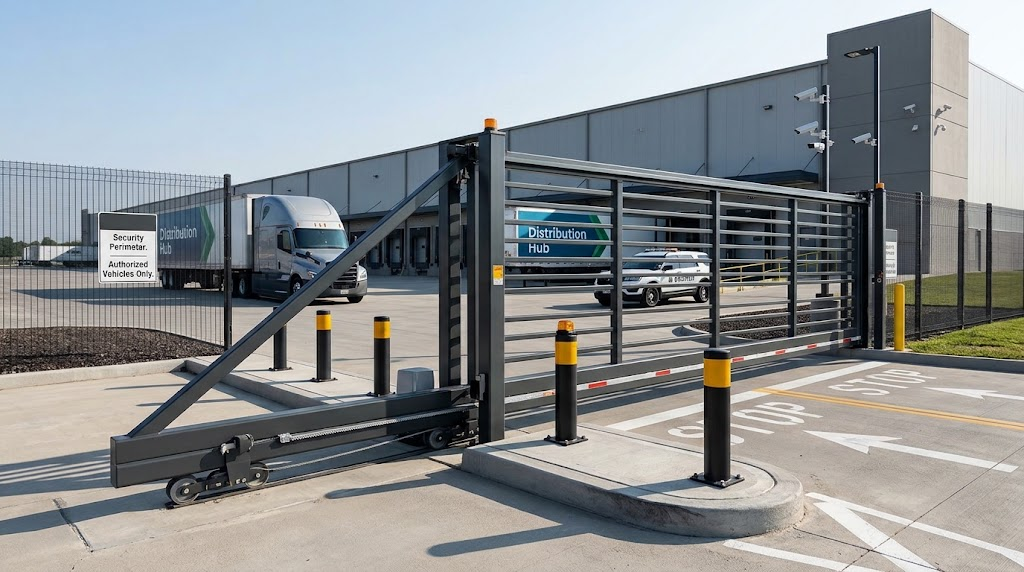
Gates are inherently the weak point of any fence line because they move. A standard rolling gate will buckle like cardboard under a high-mass impact. Heavy-duty crash gates integrate internal steel truss skeletons, robust cable-catch systems, and heavy hydraulic actuators. When closed, they lock into receiver posts engineered to transfer kinetic energy directly into the surrounding earth rather than twisting the gate frame into scrap metal.
Integrating Perimeter Hardening with Smart Access Control
Physical strength alone doesn’t create a modern security ecosystem. The best anti-ram bollards and crash gates are useless if the access control logic governing them is flawed.
Modern enterprise facilities are moving away from isolated security silos. Today’s industrial gates and rising bollards talk directly to:
- License Plate Recognition (LPR) Cameras: Automatically verifying authorized delivery vehicles and dropping bollards or opening slide gates only when credentials clear.
- Access Control Panels: Synchronizing with biometrics, long-range RFID readers, and mobile NFC credentials.
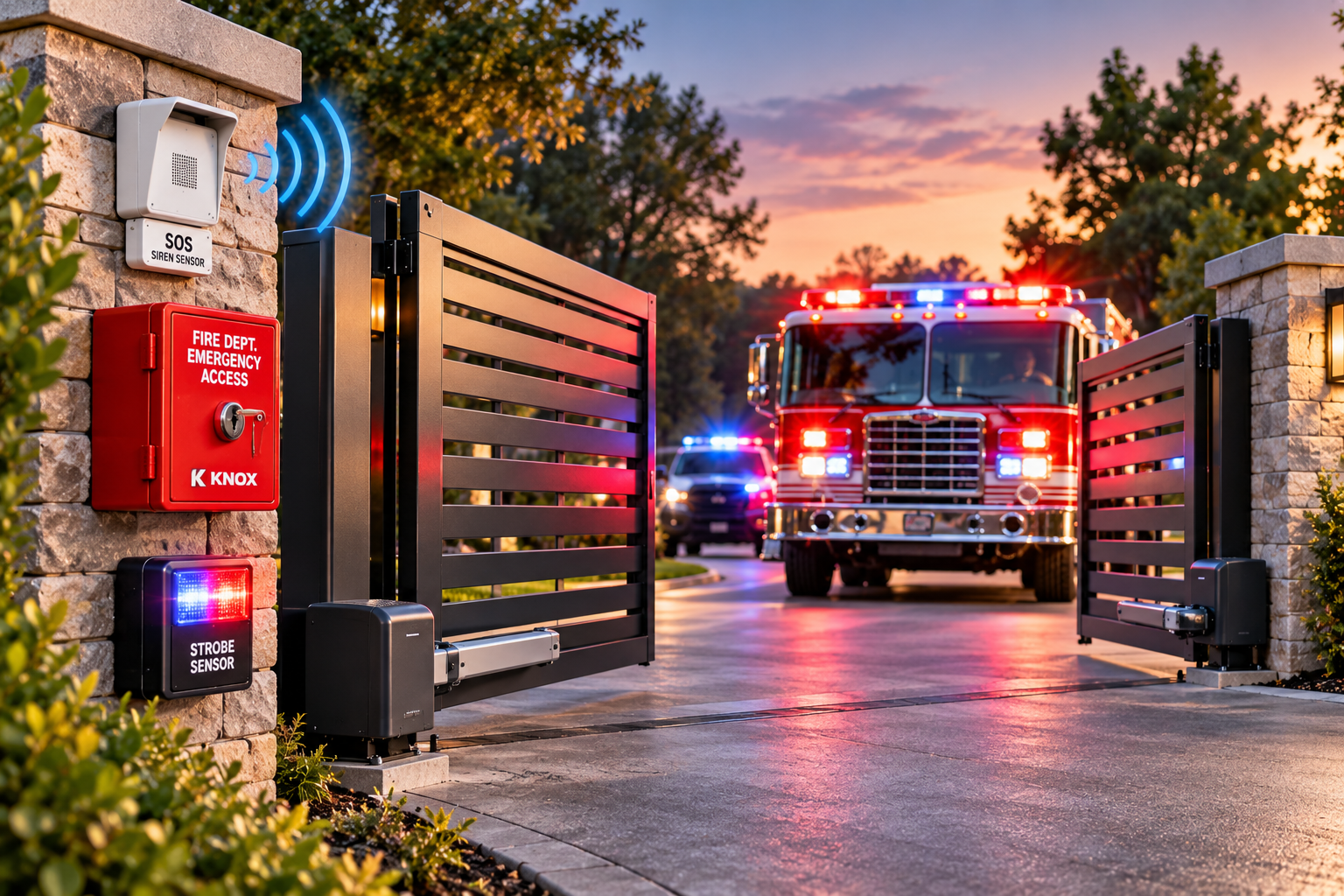
- Emergency Override Triggers: Integrating with fire alarm systems and emergency response loops to instantly drop or retract all perimeter barriers during a life-safety evacuation.
The goal is frictionless flow for authorized traffic and an absolute brick wall for everyone else.
Frequently Asked Questions
Standard bollards are often architectural accents designed to guide traffic or protect building corners from low-speed parking lot bumps. ASTM-rated anti-ram bollards, on the other hand, are heavy structural steel elements filled with high-strength concrete and anchored deep into engineered foundations. They are specifically tested and certified to absorb the kinetic energy of heavy vehicles traveling at high speeds.
Yes. High-end commercial systems are built with fail-safe mechanisms. Depending on the facility’s safety requirements, they can be configured to either remain in the locked-up position via manual mechanical pins or automatically retract using an uninterruptible power supply (UPS) or dedicated battery backup system to allow emergency egress.
Foundation depth depends entirely on the soil conditions and the specific crash rating (such as ASTM M30 or M50). However, heavy-duty anti-ram installations typically require excavation depths ranging from 3 to 5 feet, filled with dense, steel-reinforced concrete to ensure the impact load is safely dissipated into the ground.
Absolutely. While integrating these systems during initial construction is ideal, surface-mounted crash plates and shallow-foundation bollard systems have revolutionized retrofitting. Modern engineering allows high-security bollards to be installed with minimal excavation depth, making them viable for existing office parks and industrial distribution centers.
Secure Your Facility Today
Protecting your commercial property requires more than standard perimeter boundaries—it demands engineered, certified resilience. Whether you are upgrading an existing campus or designing a high-security corporate facility from the ground up, our team is here to help you integrate advanced physical hardening solutions.
- Explore our core capabilities and comprehensive perimeter options on the Weaga Home Page.
- Learn more about our specialized Commercial Gate Automation and Loading Dock Services designed to keep your facility secure and fully operational.